ATU Faculty Undergoes Design Thinking Methodology Training
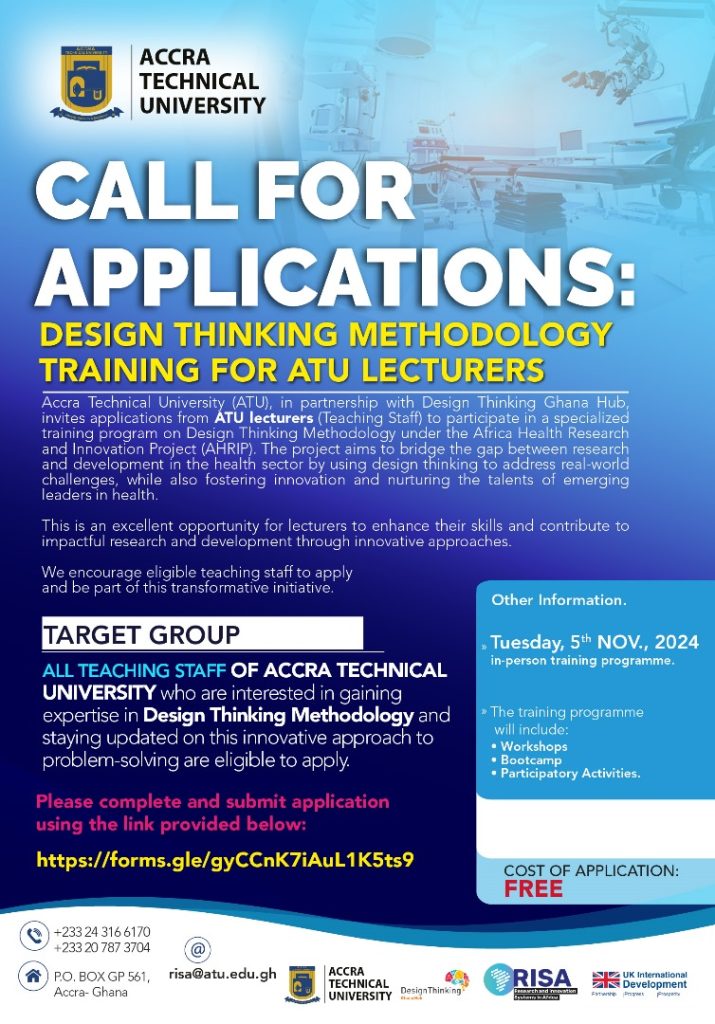
Aimed at bridging the gap between research and development in the health sector by using design thinking to address real-world challenges, the event brought together lecturers from various faculties on 5th and 6th November 2024 at the University Auditorium. The two-day training featured participatory activities focused on adopting the design thinking approach as a tool for innovative solutions to societal problems. The Chairperson of the event and AHRIP Principal Investigator, Professor Alice Constance Mensah, welcomed the participants and stressed the importance of applying design thinking principles to create meaningful, sustainable change in research and innovation, regardless of the field of study. She highlighted the need for a multi-disciplinary approach to tackling some of the most pressing issues facing the African health sector today. Throughout the event, facilitators from Design Thinking Hub, Dr. Gordon Adomdza, and Mr. Eugene Eluerkeh engaged participants in interactive discussions and collaborative exercises that explored the various stages of the design thinking process—from empathy and problem definition to ideation.Attendees were encouraged to adopt a human-centred mindset, putting the community’s needs at the centre of their innovation efforts. At the end of each session, groups presented their proposed solutions to the larger audience. These presentations were met with constructive feedback from fellow participants and facilitators, further refining the ideas and encouraging continuous improvement. In her closing remarks, Professor Mensah thanked participants for their active involvement in the two-day programme and encouraged them to exhibit the same commitment in the online sessions yet to takeplace. She encouraged all attendees to take the insights and strategies learnt during the training to their respective departments and continue exploring how design thinking can drive impactful change in theirteaching methodologies. Aimed at bridging the gap between research and development in the health sector by using design thinking to address real-world challenges, the event brought together lecturers from various faculties on 5th and 6th November 2024 at the University Auditorium. The two-day training featured participatory activities focused on adopting the design thinking approach as a tool for innovative solutions to societal problems.
ATU Orients Lecturers on Graduate Programmes as University Expands Offerings for the 2024/2025 Academic Year
The Management of Accra Technical University has held an orientation programme for lecturers on graduate programmes at the University. This event comes against the backdrop of an unprecedented number of graduate programmes rolled out for the 2024/2025 academic year, a feat following the university’s transition to a fully-fledged university in 2016. The all-important programme was held on November 11, 2024, at the university’s auditorium. Speaking as the chairman on the occasion, the Acting Vice-Chancellor, Professor Amevi Acakpovi, highlighted the university’s mandate to transform students through critical thinking, research, and innovation. He mentioned that compliance with quality standards is crucial for the sustainability of the master’s programme. He advised lecturers to prioritise attendance, direct engagement, and dedication and commitment to the programmes. Prof. Acakpovi admonished lecturers to be mindful of the difference between undergraduate and graduate teaching, stressing the need for proper preparation and high-quality teaching material. In addition, he stated unequivocally that lecturers will be rigorously appraised and their performance will be closely monitored to ensure the highest quality of education at the master’s level. Prof. J.S.Y. Kuma took lecturers through the fundamentals of pedagogy at the graduate level. The interactive session focused on effective teaching strategies for postgraduate students. According to Prof. J.S.Y. Kuma, graduate school is the university’s research arm. He encouraged lecturers to dedicate ample time to research to inspire innovations and problem-solving skills. He guided lecturers on the ethical aspects of teaching postgraduate students, highlighting the importance of empathy and humility when engaging with this group. He urged lecturers to focus on thorough class preparation and the quality of learning materials. Emphasising the need for clarity, up-to-date content, and depth, he underscored these elements as essential for delivering effective lectures at the master’s level.
What Do You Know?” Quiz Show: Engineering Faculty Emerges Winner in Close Contest
The Faculty of Engineering has emerged triumphant in the keenly contested Accra Technical University Inter-Faculty “What do you Know” Quiz on 10th November 2024 at the GTV studios. The all-exciting competition brought together the five faculties of the University to lock horns in an intellectual battle on the renowned “What do you Know?” Quiz show hosted by the famous Dan Afari Yeboah. Contestants from the Faculties of Business, Applied Sciences, Applied Arts, Engineering, and Built Environment carried the pride of their faculties by showcasing their intellectual prowess and wit in the history of the University and current global issues. The contestants had three rounds during which they answered questions correctly to amass points for a chance to win each round. The contestants were backed by their unwavering supporters from respective faculties, faculty deans, and members of the university’s management, notable among whom were the Acting Dean of the Faculty of Engineering, Dr. Tina Wemegah, Dean of the Faculty of Business, Dr. Chosniel Ocloo, Director of Public Affairs, Ms. Fausta Killian Ganaa, and Mr. Martin Owusu Amoamah. The studio was brought alive in the first round, which was a close call as the Faculty of Engineering managed to get ahead with 10 points, closely followed by the Faculty of Applied Arts, Built Environment, and Applied Sciences with 9 points each, while the Faculty of Business trailed with 7 points.In the second half, the faculties of Engineering and Applied Arts edged their opponents, turning the competition into a two-horse race with very little between them. In the third round, the Faculty of Engineering ensured daylight between them and their opponents, winning the round with 8 points and establishing a seven-point gap lead, as the Faculty of Built Environment came close with 6 points as they looked to run away with it. At the end of the contest, the Faculty of Engineering clinched the title with 27 points, and the Faculty of Applied Arts came in second with 20 points, followed by the Faculty of Built Environment and Applied Sciences with 18 points and 15 points, respectively. The Faculty of Business finished with 15 points.The contestants who represented the faculties were Comfort Sogah and Malik Abdul Rahman of the Faculty of Engineering, Kelly Kelvin and Issah Mohammed Bashir of the Faculty of Applied Sciences, Osman Sawuda and Nathaniel Kwaku Antwi of the Faculty of Built Environment, Amevor Richmond and Emmanuel Entsuah of the Faculty of Applied Sciences, and Yeboah Agyei and Obed Eduah of the Faculty of Business. The ATU Inter-Faculty Quiz is part of the activities to celebrate the 75th anniversary of the premier technical university.
TUSAAG Triumphs at ATU’s Inter-Union Cooking Competition
Accra Technical University Partners Abrantie College to Train Artisans on Modern Technologies Usage
Accra Technical University (ATU) has signed a Memorandum of Understanding (MoU) with Abrantie College, a Ghanaian institute in fashion, cosmetology, and catering, Accra Technical to equip artisans with expert knowledge in modern technologies. The collaboration between the two institutions focuses on advancing academic training and capacity-building initiatives. Together, ATU and Abrantie College aim to drive innovation, improve educational quality, and empower future leaders in fashion design, cosmetology, and catering through cutting-edge technologies. The MoU was signed in Accra on Thursday, September 12, 2024, marking a new chapter in teaching and learning at Abrantie College. Director of Abrantie College, Mr. King David Thompson, and Marketing Manager, Mr. Brian Agyei Obempong represented Abrantie College, while ATU’s Acting Vice-Chancellor, Prof. Amevi Acakpovi and Registrar, Dr. (Mrs.) Sylvia B. Oppong-Mensah, signed on behalf of the university. As part of the agreement, students from Abrantie College who complete their Certificate I and Certificate II qualifications will have the opportunity to continue their studies at ATU. ATU is currently collaborating with Abrantie College to establish a new cosmetology department. As one of the fastest-growing industries worldwide, modern technologies such as 3D printing, computer-aided design (CAD), and laser cutting have revolutionised the fashion sector. These advancements allow for precision, efficiency, and creativity, enhancing craftsmanship and enabling African artisans to compete globally. Integrating modern technologies into the cosmetics and beauty industries has attracted considerable global attention. Innovations such as artificial intelligence (AI), augmented reality (AR), and the Internet of Things (IoT) are revolutionising the sector. Recent trends include virtual try-ons with AI/VR tools, AI-driven skin analysis, wearable beauty devices, 3D-printed makeup, and automated hair analysis, all transforming cosmetology practice worldwide. Speaking at the signing ceremony, Prof. Acakpovi highlighted the importance of training artisans on the latest equipment and technologies: “As the fashion industry grows, training people on the modern equipment and technology that are here to stay is essential.” He added, “At Accra Technical University, we are at the forefront of technology, and we have experienced lecturers capable of delivering training with these modern tools. This partnership with Abrantie College aims to equip artisans with the skills to thrive in today’s competitive job market.” Mr. Thompson praised the partnership, calling it a “giant step” forward for Ghana’s fashion and cosmetology industries in Ghana. He assured that Abrantie College would continue striving to elevate these sectors to new heights. Abrantie College, based in Accra, is accredited by the Ghana Education Service (GES) and the National Vocational Training Institute (NVTI). It offers training in fashion, catering, hairdressing, and beauty care.
Call for Applications: Design Thinking Methodology Training for ATU Lecturers
ATU Cybersecurity Symposium Calls for Comprehensive Approach to Cyber Education and Awareness

Accra Technical University (ATU) has called for a comprehensive approach to cybersecurity awareness and education at its Cyber Security Symposium on Thursday, October 17, 2024, at the University auditorium. The event themed “Empowering the Next Generation Cyber Defenders: Building a Resilient Digital Future,” addressed both national and global cyber security challenges, including cybercrime, data protection, and the need for cybersecurity education. Delivering the keynote address, the Acting Vice-Chancellor, Professor Amevi Acakpovi, reiterated ATU’s commitment to prioritising cybersecurity in response to the growing digital landscape in Ghana. He noted the significant losses caused by cyberattacks such as phishing, ransomware, and malware, stressing that public data has become a prime target for cybercriminals. Professor Acakpovi called for stronger measures to protect public data and foster public awareness, emphasising the importance of compliance with Ghana’s Data Protection Act, which faces enforcement challenges. He further advocated for integrating cybersecurity education across all academic disciplines, promoting capacity-building initiatives to equip the next generation with the skills to safeguard digital infrastructure. Mr. Stephen Cudjoe-Seshie, Lead, National Computer Emergency Response Team, Cyber Security Authority (CSA), who represented the Director General, highlighted the pivotal role of information technology in driving innovation but acknowledged the associated risks. He revealed that 36% of Ghanaians have experienced data breaches in recent years, with cybercrimes such as online fraud, WhatsApp hacks, and cyberbullying becoming prevalent. Mr. Cudjoe-Seshie pointed to a troubling shortage of skilled cyber security professionals in Ghana, noting that even those available often lack critical expertise in artificial intelligence (AI), cloud computing, incident response, and application security. “There is a growing need for cyber security professionals to protect our digital infrastructure, but there’s a significant gap in the necessary skills,” he said. He also outlined the CSA’s efforts to address this gap through targeted programmes for training and licensing cybersecurity experts. Additionally, the CSA has partnered with the Ghana Tertiary Education Commission (GTEC) to incorporate cyber security into the national education curriculum. The symposium featured a panel of experts who discussed the need for inclusivity in cybersecurity education. Mr. George Babafemi, a Fintech Consultant and Board Member of eTranzact Ghana Limited, talked about the psychological effects of cybercrime and the need for sensitisation among the public as everyone stands at risk. He spoke about the fear, anxiety and distress surrounding cyber-related crimes and the irreparable damage they cause to people’s lives. Dr. Edward Ansong, a Senior Lecturer at the Department of Computer Science, University of Ghana, advocated demystifying the perception that cybersecurity is solely a tech career. He argued that cybersecurity affects all aspects of life and should be embedded in the education system, making it accessible to students across all disciplines. The Panelists agreed on the idea of enhancing cyber security education. Mr. Babafemi stressed the need for all to be vigilant in protecting data. According to him, “data is the new gold” and for every institution that deals with people’s data, it is imperative to prioritise data protection. Dr. Ansong again said that training on cyber security should not be relegated to top management but even among the least on the institutional hierarchy. He said that data protection is a collective responsibility. Director of ICT at Accra Technical University, Dr. Sylvester Hatsu, buttressed this sentiment, calling for revisions to the university’s curriculum to provide short courses and professional certifications in cybersecurity for students outside of traditional science programs. The Cyber Security Awareness Symposium was part of ATU’s celebration of October, dedicated to the national cyber security awareness celebration. The event was a partnership between Accra Technical University and the Cyber Security Authority (CSA) and sponsored by eTranzact Ghana Limited, Digital Arena, Tellingent (GH) Systems and Improtech Systems.
ATU FlexiLab Roadshow: Students Collaborate with Industry to Address Agricultural Sector Challenges
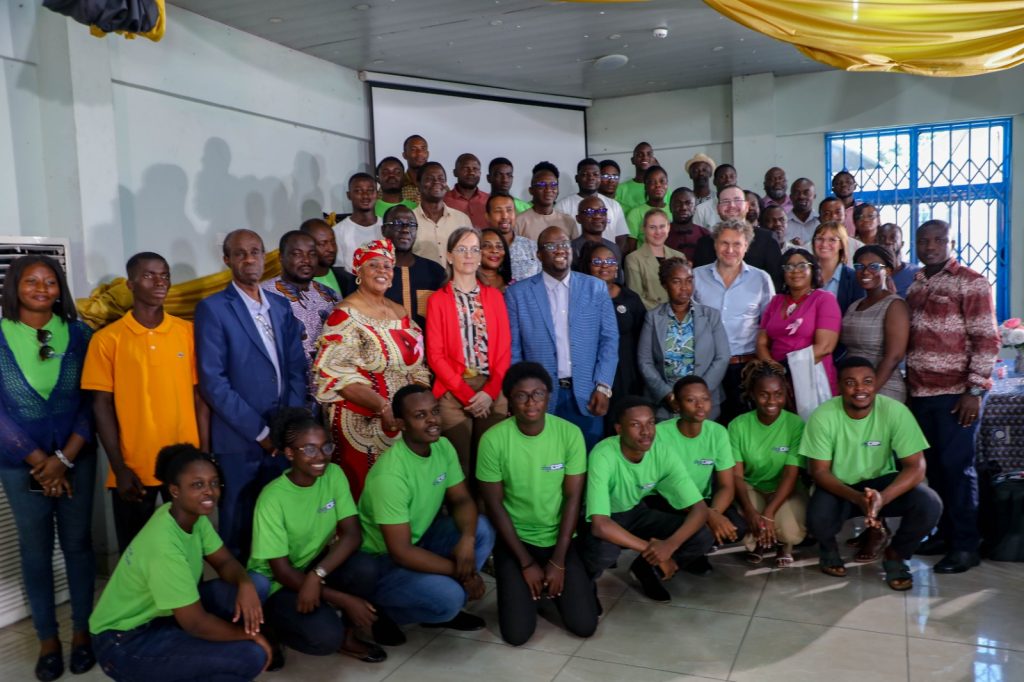
Accra Technical University has organised its FlexLab Junior Consultant Roadshow with the support of German Cooperation projects under the Special Initiative “Decent Work for a Just Transition” through sequa gGmbH. The two projects are coordinated in Ghana by two German associations; the Federation of German Wholesale, Foreign Trade, and Services (BGA) and the AFOS Foundation for Entrepreneurial Development Cooperation (AFOS). Delivering the keynote address, the Acting Vice-Chancellor of ATU, Professor Amevi Acakpovi, stressed the crucial role of digital tools in solving pressing societal problems. He pointed out that as a Technical and Vocational Education and Training (TVET) institution, ATU’s mandate is to prepare students with the skills needed to be self-reliant in the job market, particularly in a country facing significant unemployment challenges. He further announced the university’s Centre for Entrepreneurship and Incubation Services, (CEIS) which focuses on equipping students with entrepreneurial skills to transform ideas into sustainable ventures. Professor Ernest Winful, a key member of the project’s coordination team, described the Junior Consultant initiative as a platform to promote employability. He noted that the project’s primary goal is to provide participants with practical digital skills, preparing them to tackle industry challenges. Hannah Schlingmann of AFOS expressed her outfit’s excitement about being part of the project. She announced the launch of the 4th cohort of the Junior Consultant programme, which will have a special focus on empowering young women by raising awareness and facilitating placement services within the global workforce. The event featured presentations by Junior Consultants, who had spent the previous two to three weeks developing digital solutions to challenges faced by companies in the agricultural sector. These students collaborated with companies such as SPEG, SHEPAG, and ASPEG to design mobile applications and websites aimed at addressing operational issues within the sector. Christopher Mars from BGA German Cooperation shared his experience of working with the Junior Consultants, expressing his satisfaction with the solutions presented and encouraging more stakeholders to support the initiative in achieving its long-term goals. The FlexiLab Junior Consultant Roadshow forms part of the broader BGA Project, which is backed by BGA, AFOS, and Accra Technical University and funded by the German Cooperation, Invest for Jobs, and Sequa, aiming to equip students with practical digital skills to solve industry-specific challenges. .
ATU Launches Phase Two of AHRIP to Mentor Emerging Innovators; Secures $160K Grant
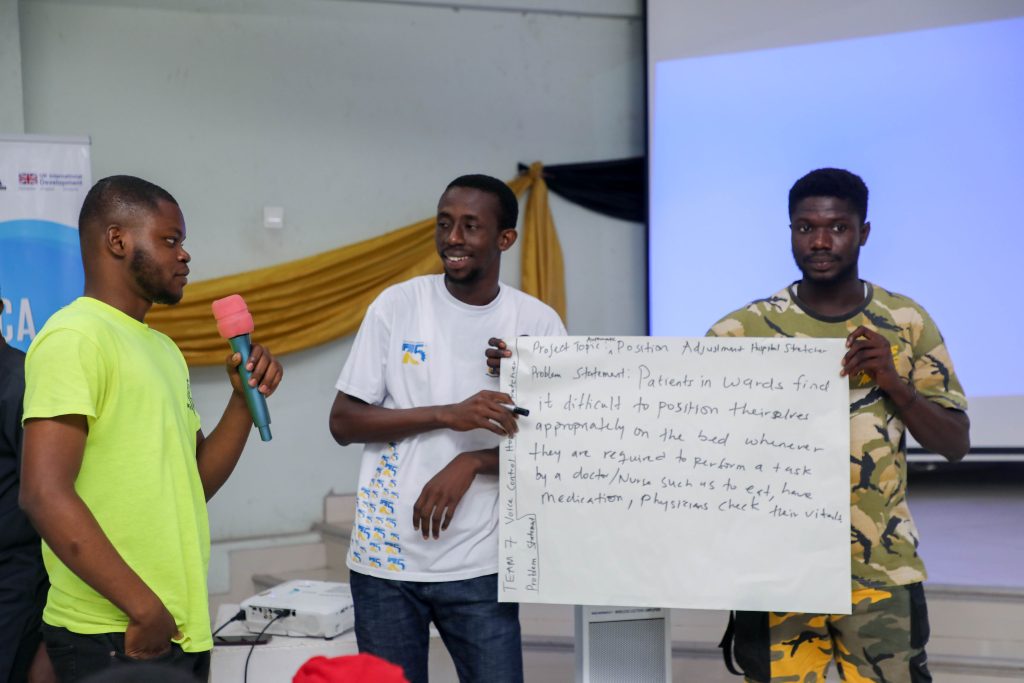
Professor Alice Constance Mensah, Principal Investigator, Africa Health Research and Innovation Project (AHRIP), says the Accra Technical University (ATU) has received a grant of $160,000 to scale up innovative projects developed by its students. The grant will help ATU establish an Innovation Hub Centre to develop and mentor the creativity of students. Prof Mensah said this at the launch of phase two of the Africa Health Research and Innovation Project in Accra. Under the first phase, ATU, in collaboration with the Design Thinking Ghana Hub, secured a $152,869 grant from UKaid through the Research and Innovation Systems for Africa (RISA) Fund. The project aims to bridge the gap between research and development in the health sector to solve real-world challenges and harness the talents of young emerging leaders in health innovations. The first phase of the project saw some students at ATU who have designed groundbreaking innovations to improve healthcare delivery in the country. Some of the innovations included a blood warmer, thermoelectrical vaccine carrier, dehumidifier, oxygen bags and vest, potable dialysis machine, aerospray vacuum stainer, and auto-bin waste segregator, among others. Out of the 175 students who participated in the project, 22 prototypes of the innovations were selected and displayed at the innovation fair of the Africa Health Research and Innovation project. Prof. Mensah, who is also Dean, Faculty of Applied Science, ATU, said the grant was given because of the innovative projects developed by the students under the first phase of the project. The Professor said phase two of the project would train some staff of the University in innovation and select 17 prototypes for scale-up. That, she stressed, would help sustain the project, urging the students to take advantage of the opportunity to enhance their creative skills. Prof Amevi Acakpovi, Acting Vice-Chancellor, ATU, said phase two of the project was part of the University’s strategic plan to establish an incubation centre to promote critical thinking and innovation. The incubation centre, he said, would provide some form of mentorship and training to students to transform their prototypes into a viable enterprise for commercialisation. The Vice-Chancellor expressed excitement that the projects developed by the students would project the image of the University on an international pedestal.
Deputy Education Minister Lauds ATU for Advancing TVET and STEM

The Deputy Minister of Education in charge of Technical and Vocational Education and Training (TVET), Professor Kingsley Nyarko, has praised Accra Technical University (ATU) for its remarkable strides in promoting STEM (Science, Technology, Engineering, and Mathematics) education and technical training. His commendation came during a visit to the university on Tuesday, October 8, 2024, as part of an ongoing initiative to evaluate the progress of TVET institutions across the nation. During the visit, Prof. Nyarko lauded ATU’s commitment to blending practical training with academic knowledge, a key element of STEM education. He noted that the university plays a critical role in preparing the future workforce with the hands-on skills essential for Ghana’s industrial growth. His tour included stops at important university facilities such as the TV studio, the Amatrol Lab, and the Drone Center, all of which reflect ATU’s progress in integrating modern technology into its curriculum. Prof. Nyarko emphasised the significance of these facilities in narrowing the gap between theoretical knowledge and practical application, especially in today’s rapidly evolving industrial environment. “The skills that students acquire here are crucial in preparing them to meet workforce demands,” he stated. Additionally, the Deputy Minister visited other key centers, where he was briefed on various innovative projects currently being undertaken by the university. He highlighted that ATU’s pioneering efforts in technical education place it at the forefront of Ghana’s STEM and TVET advancement. The Acting Vice-Chancellor of ATU, Professor Amevi Acakpovi, expressed gratitude for the Deputy Minister’s visit and his encouraging remarks. He reiterated that the university’s dedication to STEM and TVET aligns with the government’s vision for technological and industrial development. “Your recognition reinforces our commitment to remain leaders in TVET education. We take pride in contributing to the nation’s development by equipping our students with the necessary skills and knowledge for the future,” Professor Acakpovi remarked. Prof. Nyarko assured the university of the Ministry’s continued support, stressing that ATU’s advancements in STEM and TVET are vital to the country’s educational and economic aspirations. He reaffirmed that the Ministry would continue collaborating with institutions like ATU to ensure that technical education remains robust and responsive to the needs of a technology-driven economy. As a leader in practical, hands-on education, Accra Technical University continues to enhance its capabilities in training students across various technical fields, making a significant contribution to Ghana’s industrial and economic development. The Deputy Minister’s acknowledgment of these achievements underscores the importance of TVET and STEM education in shaping the nation’s future.